Short answer: up to 50 pieces DTF, over 100 screen printing. Between 50 and 100 the number of colours in the design decides: the more there are, the more DTF pays off.
Below is the longer version, because it also depends on a few things sellers usually don't mention.
Where that line comes from
Screen printing needs screens prepared, a separate one for each colour in the design. It's a fixed cost you pay once, whether you print 10 T-shirts or 1000. A five-colour logo means five screens.
DTF has no set-up cost. The design is printed onto film and heat-pressed, so the first piece costs the same as the hundredth.
DTF for a small run: no start-up cost, full colour and shading at the same price, orders from a single piece.
Screen printing for a small run: the cost of screens spread over 10 T-shirts can double the unit price. At 300 pieces the same cost is barely noticeable.
Methods compared
| Method | Run where it pays off | Full colour | Durability | Notes |
|---|---|---|---|---|
| DTF | from 1 pc | yes, no surcharge | high | The most versatile method |
| Screen printing | from 100–150 pcs | surcharge per colour | very high | Best for large runs |
| Flex / flock | from 1 pc | no, one colour | high | Lettering, numbers, simple shapes |
| Embroidery | from 5 pcs | limited | highest | Caps, polo shirts, workwear |
| Sublimation | from 1 pc | yes | very high | Light-coloured polyester only |
DTF: what it actually is
The design is printed onto special film, coated with adhesive powder and heat-pressed into the fabric. The name stands for "direct to film".
In its favour:
- →Full colour, gradients and shading at no extra cost
- →Works on cotton, polyester and blends
- →Works on dark fabrics: white is printed as a base layer
- →No minimum order
- →Short turnaround, as there's no screen preparation
Limitations worth knowing:
- →You can feel the print with your fingers: it's a layer on the fabric, not dye in the fabric
- →With very large designs across the whole front, the T-shirt breathes less
- →For runs of 100–150 pieces and up with a simple design, screen printing will simply be cheaper
Screen printing: when it makes sense
Ink is pushed through a mesh straight onto the fabric. A method known for decades and still unbeaten for large runs.
It makes sense if you meet all three conditions at once:
- →You order at least 100–150 pieces
- →The design has no more than 2–3 colours
- →You don't need gradients or photos in the design
If any one of these doesn't apply, DTF wins on price or capability.
A typical mistake: a business orders 30 T-shirts for an event and is told screen printing is the method for businesses. They pay for screen preparation, even though at 30 pieces that cost is spread over so few T-shirts that the unit price becomes absurd.
Flex and flock: for lettering and numbers
Single-colour vinyl cut on a plotter and heat-pressed. Flex is smooth, flock has a velvet texture.
It works for names on team shirts, numbers and simple logos with sharp edges. It doesn't work for designs with photos, shading or many colours: each colour is a separate layer of vinyl, and after three layers it gets stiff.
Embroidery: when it's worth paying more
Embroidery costs more and takes longer, but it looks more solid and survives practically any number of washes. Natural uses are caps, polo shirts, jackets and workwear: anywhere a garment works every day for years.
There's one limitation: embroidery can't reproduce fine details or gradients. A logo with thin text has to be simplified for embroidery.
What it costs with me
Prices including the garment and the print, net.
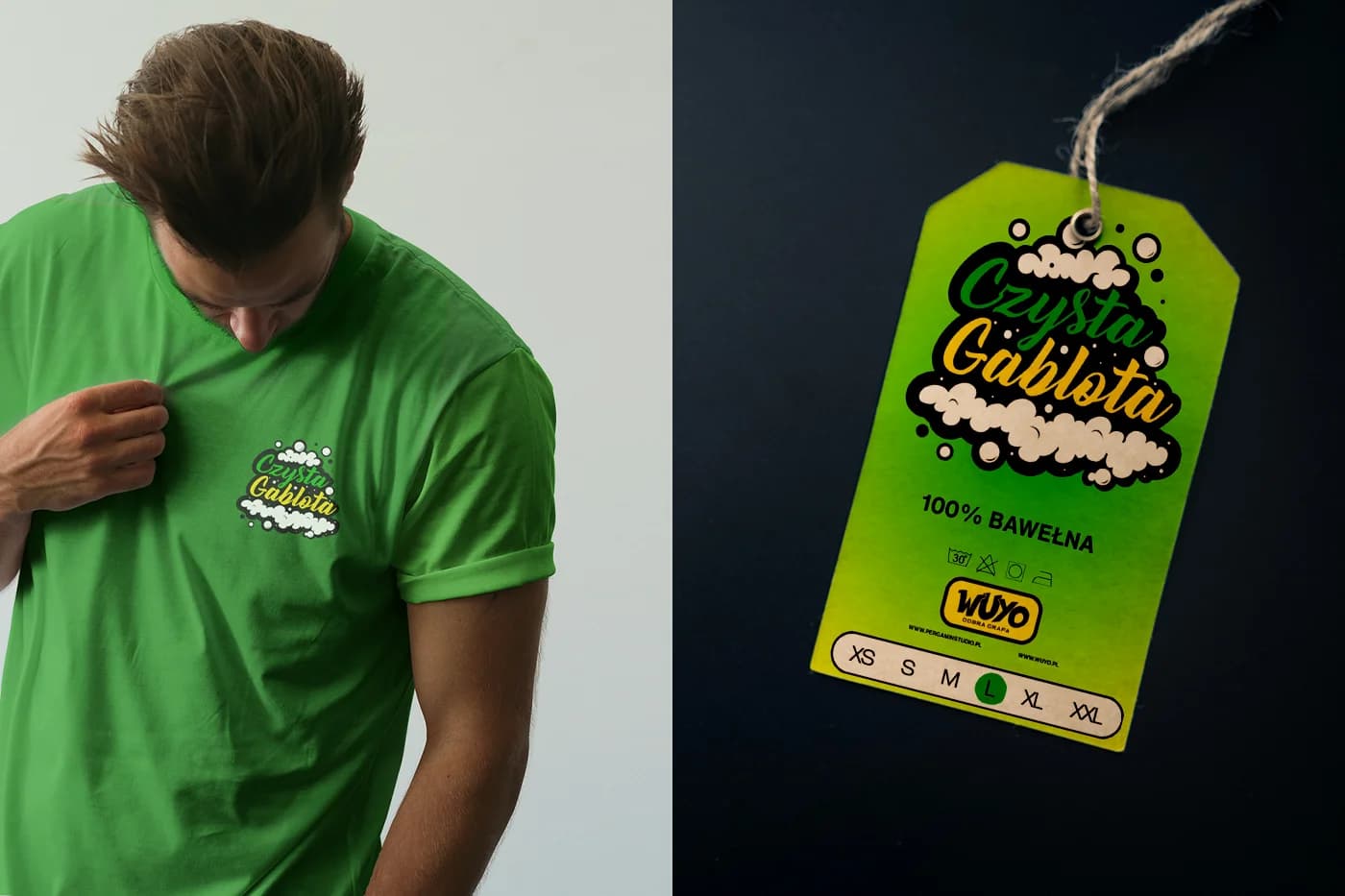
DTF-printed T-shirt
79 PLN per piece
205 g cotton, unisex, full-colour print. No minimum: you can order one. From 5 pieces 65 PLN, from 20 pieces 49 PLN each.
DTF-printed hoodie
199 PLN per piece
280 g hoodie, with or without a hood. From 5 pieces 169 PLN, from 20 pieces 139 PLN each. Logo on the chest or a large design on the back. 2–4 days.
Printing on your own clothes
from 45 PLN/pc
Already have T-shirts or hoodies? Bring your own and I'll press the print on. 1–2 days.
Lettering and numbers (flex, flock)
from 35 PLN/pc
Single-colour lettering or numbers cut from vinyl. For team numbers and simple logos.
Name personalisation is an extra from 15 PLN per design, embroidery from 45 PLN with a minimum of 5 pieces. The full list is on the apparel printing page.
Tell me how many pieces and what design, and I'll say which method is cheaper in your case.
Ask for a quoteHow to prepare a design for printing
The requirements are gentler than for paper print, but a few things must be in place.
If you only have your logo as a low-quality raster image, it can be recreated as a vector. Why the vector version matters so much, I wrote in how to choose a logo designer.
How to wash it so the print lasts
- →Wash inside out, at up to 40 degrees
- →Don't iron directly on the print; if you must, use a cloth and iron inside out
- →Skip the tumble dryer: high heat shortens the life of the print
- →Avoid bleach and chlorine-based products
Treated like this, a good DTF print easily survives dozens of washes without cracking or fading.
A file for garment printing is prepared much like a file for paper print; I collected the rules on resolution and colour in how to prepare a print-ready file.
FAQ
Which is better: DTF or screen printing?
It depends on the run. Up to about 50 pieces definitely DTF, as there's no screen set-up and full colour costs nothing extra. Over 100–150 pieces with a 2–3 colour design, screen printing will be cheaper. In between, the number of colours in the design decides.
Can I order one printed T-shirt?
Yes, DTF has no minimum. One piece costs 79 PLN with me including the T-shirt, or from 45 PLN if you bring your own. At 5 pieces it goes down to 65 PLN, at 20 to 49 PLN. With screen printing single pieces don't pay off because of the screen preparation cost.
Does a DTF print wash off?
No, if you wash it sensibly: inside out, up to 40 degrees, no tumble dryer and no bleach. Treated like that, the print survives dozens of washes. Fading and cracking almost always come from washing at high temperatures or ironing directly on the print.
Does the print work on dark T-shirts?
Yes. With DTF a white base is printed under the coloured design, so colours stay vivid even on black fabric. It's one of DTF's main advantages over older heat-transfer methods.
How long does a printed T-shirt order take?
With me 2–4 working days from approving the design, and 1–2 days for printing on supplied clothing. Embroidery takes longer and I agree the timing individually. I give a specific date with the quote, as it depends on my current workload.
What do I need to order?
A logo or design as a vector or in high resolution with a transparent background, the T-shirt sizes and where the print should go. If you don't have a ready design, I can design it; that's a separate item in the quote.