Many small businesses start with a random logo made in Canva, then order business cards with a different font, and post graphics in completely different colours on Facebook. The result? The business looks amateurish, even if the service is great.
Brand identity is the answer to that problem. And it isn't reserved for corporations.
Brand identity is a set of rules deciding how your business looks everywhere: logo, colours, typefaces and the rules for using them. What exactly makes it different from a logo and what it should include, I described in brand identity for a business.
This guide is about something else: in what order to order it all, so you don't spend money on things that won't give you anything at this stage. Prices in PLN, net.
Why the order matters
The most common scenario in a small business goes like this: business cards first, because they were needed for a trade fair. Then a flyer from another contractor, in a slightly different shade. Then a website where the logo is already in its fourth version.
Each of these materials is fine on its own. Together they add up to nothing, and after a year they all have to be redone. That's why the order can matter more than how much you spend.
The customer sees the same colours and font on the business card, website and Instagram. They remember the brand, not a single contact. When they look for the service again, they come to you, not a competitor.
Every material looks different. The customer doesn't connect them with one business. It feels makeshift, even if the quality of the service is high.
Where to start: step by step
Step 1: Decide who you are and who you work for
Before a designer draws anything, you need to answer three questions:
- →Who are your customers? (age, industry, expectations)
- →How are you different from the competition?
- →What word would you use to describe your business? (e.g. reliable, modern, local, exclusive)
It isn't philosophy: it's the foundation for every design decision.
Step 2: Start with the logo
The logo is the starting point for the whole identity. A good designer will make it work in black and white, at small and large sizes, on light and dark backgrounds.
Avoid logos that are too complicated: at small sizes (favicon, stamps) they become unreadable.
Step 3: Set the colour palette
Colour is the strongest element in building recognition. 2–3 colours are enough: a main colour, a supporting colour and a neutral (white or black).
Important: colours should be written as HEX or RGB (web, screens) and CMYK (print). Without these codes every print shop will reproduce the colour differently.
Step 4: Choose fonts and stick to them
One heading font, one body font, and no exceptions. That's enough. More fonts means visual chaos.
Step 5: Gather the rules in a brand book
A brand book is a document describing how to use the logo, colours and typefaces. With it everyone (the print shop, the developer, whoever runs your social media) knows how your business should look and doesn't have to call to ask.
This step only makes sense when more than one person makes your materials. Before that, a file with your colours and the logo in a few versions is enough.
What to do first on a small budget
The order that works for your first spending on how your business looks:
1. A logo and two colours. Without them, every following material will need fixing anyway.
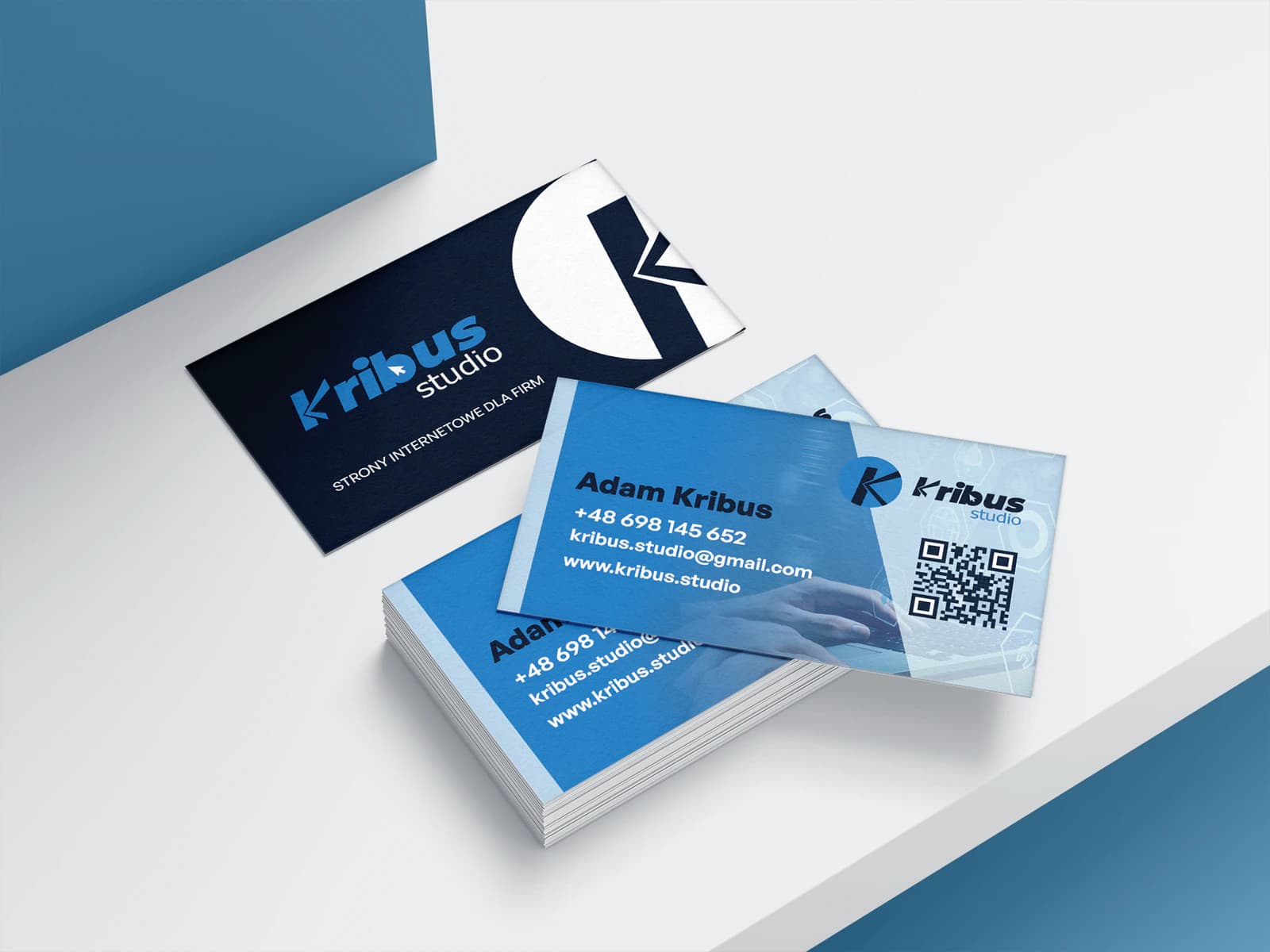
2. A business card and an email signature. Two items you use every day that cost nothing to maintain.
3. What you actually use. A flyer, if you hand out flyers. Social media templates, if you actually post there. Not the other way round.
4. A brand book. Only when several people work on your materials.
The minimum set a small business can manage with for the first year: a logo in three versions, two colours with codes for screen and print, one typeface and a business card. Everything else you add when it starts being needed.
What's essential and what can wait
Not every business needs a 60-page brand book straight away. For a small business this is enough:
| Element | Essential? |
|---|---|
| Logo (vectors, versions, colour variants) | Yes |
| Colour palette with codes | Yes |
| Typography (2 fonts) | Yes |
| Business card | Yes |
| Letterhead | If you send letters and offers on paper |
| Email signature | Yes |
| Brand book | When more than one person makes your materials |
| Social media templates | With an active profile |
| Flyer / catalogue | Depends on the industry |
A new business: starter materials list
Setting up a business or just opened one? This is a set that will last the first year, in the order worth ordering it.
From day one:
In the first months:
Once the business takes off:
How much to spend on it
To start, a logo alone is enough: with me from 890 PLN. If you want the full set straight away, a package is cheaper than the same things ordered separately.
| Package | What it includes | Price | Separately |
|---|---|---|---|
| Marka Mini | Logo in 3 versions + 100 business cards designed and printed | 1,090 PLN | 1,239 PLN |
| Marka Start | Logo, mini brand book, 150 printed business cards, email signature | 1,490 PLN | 2,119 PLN |
| Firma w Internecie | Marka Start + website up to 5 pages, form, map, local SEO, training, a month of care | 3,490 PLN | 5,308 PLN |
| Pełny Start | Firma w Internecie + 300 business cards, flyer, social templates, Google profile, 3 months of care and visibility | 5,900 PLN | 8,268 PLN |
I collected the full prices for brand identity alone in brand identity for a business, and website prices in how much does a website cost.
One thing to remember when browsing offers: a "full brand identity" for under 300 PLN is practically always a generator template, with no vector files and no copyright transfer. A year later you pay a second time.
The most common mistakes small businesses make
- →Making the logo yourself in Canva: no vectors, no originality, often infringing rights to the elements
- →Changing colours and fonts with every new material: kills recognition
- →No source files: when the designer disappears, you can't edit the design
- →Starting with business cards without a logo: then everything has to be redone
Summary
Order matters more than budget. Start with a logo and two colours, add a business card and email signature, and add the rest when it actually starts being needed.
Not sure which step you're at? Write to me and I'll tell you specifically what makes sense at this stage and what can safely wait. I work as a graphic designer in Rzeszów and with clients from all over Poland; the full offer is on the logo design page.
Ask about brand identity
Get in touch →I wrote more about what exactly a brand identity includes in brand identity for a business. Logo prices on their own are broken down in how much does a logo cost, and if you're looking for someone local, see a good graphic designer in Rzeszów.
FAQ
Where do I start building a brand identity?
By deciding who the business is and who it's talking to; only then is the logo made. The order is: positioning, logo, colour palette, typography, and finally writing down the rules. Starting with a logo without that first step ends with a mark that needs fixing after a year.
What materials does a new business need?
To start: a logo in several versions, business cards, an email signature and a Google Business Profile. In the first months, a simple website and email on your business domain. The rest (flyers, sign, social templates) you add when they're actually needed. With me a logo, website and business cards together in the Firma w Internecie package cost 3,490 PLN.
What's enough to begin with?
A logo in three versions, two colours written as codes for screen and print, one typeface and a business card. With that set a small business functions fine for the first year, and every following material has something to refer to.
How much does brand identity for a small business cost?
A logo in three versions starts at 890 PLN, a logo with a mini brand book is 1,190 PLN, and the Marka Start package (logo, brand book, 150 printed business cards and an email signature) is 1,490 PLN. Offers under 300 PLN for a full identity are practically always a generator template, with no vectors and no copyright transfer.
Does a small business really need brand identity?
It needs consistency, not a thick document. A logo in a few variants, two or three colours and two typefaces used consistently are enough. That already sets apart a business that looks serious from one where every material looks different.
How many colours should a brand identity have?
Usually two main ones plus one accent and a neutral base: white and black or grey. More colours make consistency harder, because with every new material you have to decide again which one to use.
In what order should I order print materials?
Business cards first, because you use them with every contact. Then what follows from your industry: a flyer if you hand them to customers, a folder if you submit offers on paper, stickers if you leave equipment behind. Shop sign and van wrap last: they're the most expensive and hardest to replace.
What should a brand book include?
Logo variants and the rules for using them, minimum sizes, clear space, a colour palette with CMYK and RGB values, typefaces and examples of use. Plus a list of don'ts, what you must not do with the logo: often the most useful page of the whole document.